
Best AI Tools for Small Business Owners
Quick Answer
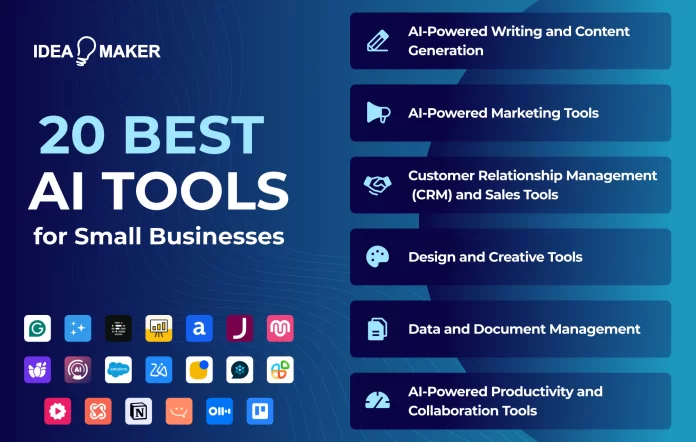
The best AI tools for small business owners are ChatGPT for writing, Claude for complex work, Canva for design, QuickBooks for finances, and HubSpot for CRM. Start with free plans and pay only for what saves you time. If a tool sparks a business idea, form an LLC for $39 with Northwest.
Introduction: The
AI Shift I Didn’t See Coming
I’ll be honest with you. When I first heard about AI tools for small
business, I rolled my eyes. I figured it was another tech fad designed
to sell software to people who didn’t need it.
I was wrong.
About four years ago, I was drowning in administrative work. I spent
hours drafting emails, chasing invoices, managing client communications,
and trying to keep my books straight. I was running a business, but I
felt more like an overworked admin assistant.
Then I tried one tool. Just one. And within a week, I got back about
five hours of my time.
Those reclaimed hours are how side businesses get built. If one of these tools sparks a business of your own, you can form your LLC for $39 with Northwest.
Start Your LLC for $39 with Northwest →Lowest 3-year cost we found: Northwest $289 vs Bizee $298 vs ZenBusiness $497 (service fees; state fees extra). Northwest also puts its address on your public filings instead of yours where the state allows.
That was the moment I realized AI wasn’t just a buzzword. It was a
practical solution to problems I had been grinding through for
years.
Now I use AI daily. Not because it’s trendy, but because it works. My
clients get faster responses. My invoices go out on time. My marketing
runs more consistently. And I actually have time to think about growing
the business instead of just keeping it running.
This article is about the AI tools I’ve actually used and recommend
to other small business owners. I’m not going to list every tool on the
market. I’m going to tell you what works, what doesn’t, and where to
start.
Why This Matters in 2026
The numbers are hard to ignore. A recent survey by Reimagine Main Street found that most small business owners believe adopting AI is key to staying competitive. More than half are actively looking for ways
to integrate AI into their work, and about one in four have already done
it .
This isn’t a trend. This is a fundamental shift in how businesses
operate.
Anthropic, the company behind Claude, recently launched Claude for
Small Business, a suite of tools designed specifically for smaller
companies. Their reasoning is straightforward: small businesses account
for 44% of US GDP and employ nearly half the private sector workforce,
but their adoption of AI has lagged behind larger enterprises .
The company’s head of US small and medium businesses put it bluntly:
“The software industry has been built for enterprises, for VC-backed
startups, and consumers, but not the 50-employee HVAC contractor or the
25-person landscape company” .
Here’s what I’ve seen firsthand: the gap between businesses using AI
and those ignoring it is widening fast. The businesses using AI are
responding to customers faster, producing more consistent marketing, and
making better decisions with their financial data.
The businesses ignoring it are falling behind. Not because they’re
less capable, but because they’re still doing manually what their
competitors are automating.
These tools do more than save time. They can become the foundation of a brand-new business. Whether you use AI to run your own company or to offer AI-powered services to other local owners, you will need an LLC to operate properly, and the service I keep coming back to is Northwest Registered Agent.
Form Your LLC with Northwest for $39 →
The Best AI Tools
for Small Business Owners
I’ve tested dozens of AI tools. Some are excellent. Some are a waste
of money. Here are the ones I actually use and recommend.
ChatGPT (OpenAI) –
Your Everyday AI Assistant
Best for: Quick writing tasks, brainstorming,
drafting emails, customer replies
ChatGPT is the tool I recommend most to first-time business owners.
It’s the easiest to start with and the most versatile.
I use it for drafting emails, creating social media captions,
brainstorming marketing angles, and even writing first drafts of blog
posts. It won’t replace your judgment or your voice, but it will get you
past the blank page.
How I use it: When I need to respond to a customer
email, I paste the original message into ChatGPT and ask it to draft a
professional reply. I review, tweak, and send. What used to take 15
minutes now takes 3.
What it costs: Free for basic use. $20/month for
ChatGPT Plus, which gives you better performance and access to more
advanced features .
Real-world example: A home services business owner I
know uses ChatGPT to instantly generate responses to new leads. He says
it helps him reply faster and win more jobs .
My take: This should be your first AI tool. It’s
free, easy to use, and immediately useful for almost any business.
Claude (Anthropic)
– Your Big Project AI Partner
Best for: Strategy-heavy work, marketing campaigns,
document analysis
Claude is ChatGPT’s biggest competitor, and I’ve come to prefer it
for certain tasks. It can handle larger files and more context than
ChatGPT, which makes it better for complex projects .
In May 2026, Anthropic launched Claude for Small Business, a new
suite that connects Claude directly to tools like QuickBooks, PayPal,
HubSpot, and Canva. You can toggle it on inside Claude Cowork, connect
your business tools, and pick the job. Claude does the work, and you
approve before anything sends, posts, or pays .
Here’s what that looks like in practice:
- Payroll planning: Claude pulls your cash position from QuickBooks,
reconciles it against PayPal settlements, ranks overdue invoices, and
drafts reminder emails for each one . - Marketing campaigns: Claude finds slow stretches in your revenue,
analyzes your HubSpot campaign performance, drafts a promo strategy, and
generates assets in Canva . - Month-end close: It reconciles your books against PayPal
settlements, flags mismatches, writes a plain-English profit and loss
statement, and exports a close packet you can forward to your
accountant .
Anthropic also offers a free on-demand AI training course
co-developed with PayPal, taught by small business owners who’ve already
built AI into their operations .
What it costs: Free for basic use. Paid plans start
around $20/month. Claude Max subscription ranges from $100 to $200 per
month for advanced features .
My take: If you’re doing complex marketing campaigns
or managing serious finances, Claude is worth the investment. The
connector feature is a game-changer for business owners who hate
switching between tabs.
Canva AI –
Professional Design Without a Designer
Best for: Social media graphics, ads, presentations,
branded visuals
Canva’s AI features, especially Magic Design, let you create polished
graphics in your brand style in seconds. You don’t need design
experience. You just tell it what you want and it generates layouts you
can tweak .
I use Canva for social media posts, email headers, presentation
slides, and simple ads. It saves me from hiring a designer for every
small project.
How I use it: I save my brand kit (colors, fonts,
logo) in Canva. Then when I need a social graphic, I pick a template and
let the AI adjust it to my brand. What used to take 45 minutes now takes
5.
What it costs: Free version available. Pro version
is about $18/month ($180/year). Some features require the Pro version .
Pro tip: Pair Canva with an image generator like
Midjourney. Generate unique images in Midjourney, then drop them into
Canva templates for a more distinctive look .
My take: If you create visual content regularly,
Canva AI is essential. It’s the cheapest way to maintain
professional-looking marketing.
QuickBooks
Online + AI Insights – Financial Management
Best for: Accounting, invoicing, cash flow
forecasting
Let’s be real: most small business owners hate bookkeeping.
QuickBooks automates invoicing, tracks expenses, and uses AI for cash
flow forecasts and reminders .
The AI features help you understand your financial health without
being an accountant. It flags issues, predicts cash flow problems, and
generates plain-English summaries you can actually understand.
What it costs: Starts around $38/month. No free
tier, but the ROI is obvious if it saves you from mistakes or helps you
catch problems early .
My take: This is one of the few tools I recommend
paying for even if you’re just starting out. Your financial foundation
is too important to mess up.
HubSpot – Smarter CRM
and Email Marketing
Best for: Customer relationship management, email
marketing, lead tracking
HubSpot organizes your customer data, automates email campaigns, and
uses AI to personalize outreach and track engagement . Its AI features
include content generation, lead scoring, predictive analytics, and
conversational chatbots for your website .
For sales teams, HubSpot provides AI-assisted email drafting and call
summarization. For marketing teams, it offers content suggestions and
campaign optimization .
What it costs: Free plan available. Paid plans start around $9 per seat per month, billed annually.
My take: If you’re managing more than a handful of
clients, you need a CRM. HubSpot’s free plan is good enough to start,
and the AI features make it worth the upgrade as you grow.
Grammarly – Polish
Every Customer Interaction
Best for: Polishing emails, proposals, customer
responses
Clear communication builds trust. Grammarly helps ensure everything
you send is professional and easy to understand .
I use it for every important email and proposal. It catches mistakes
I’d miss and makes my writing clearer. It’s not a substitute for good
communication, but it’s a safety net.
What it costs: Free version available. Premium is
$12/month.
My take: This is a low-cost, high-return tool. If
you send emails to clients, you should use it.
Zapier – Connect Your
Tools Without Code
Best for: Automating workflows between different
apps
Zapier links thousands of applications without requiring technical
skills. Its AI features include natural-language workflow building,
where you describe an automation in plain English and Zapier suggests
the steps .
I use Zapier to connect tools that don’t integrate natively. For
example, when someone books a consultation, Zapier adds them to my email
list, creates a task in my project management tool, and sends me a
notification. All automatically.
What it costs: Free plan available for basic
automations. Paid plans start around $30/month.
My take: This is a power user tool. If you’re not
comfortable with automation, skip it until you are. But if you know what
you’re doing, it’s incredibly useful.
Fireflies.ai –
Automatic Meeting Notes
Best for: Client meetings, team check-ins,
brainstorming sessions
Fireflies records and transcribes meetings, creating searchable notes
and summaries . No more scrambling to take notes or missing key points
during client calls.
What it costs: Free plan available. Paid plans start
around $18/month.
My take: This is one of those tools you don’t think
you need until you try it. Then you wonder how you managed without
it.
Notion AI –
Organize Your Business in One Place
Best for: Task management, notes, workflows,
internal knowledge
Notion combines documents, databases, and project tracking in one
workspace, with AI features that operate across all of them. The AI can
draft content, summarize pages, translate text, and answer questions
based on your workspace’s stored knowledge .
I use Notion to organize everything: client notes, project tracking,
standard operating procedures, and strategic planning. The AI helps me
find information quickly and draft documents without starting from
scratch.
What it costs: Free version available. Paid plans
start around $10/month.
My take: If you’re drowning in scattered
information, Notion is a lifesaver. It takes effort to set up, but once
it’s running, it’s the central hub of your business.
How Much AI Tools Actually
Cost
Let me be direct about costs. If you subscribed to every tool I’ve
mentioned, you’d spend about $170 a month, or roughly $2,000 a
year .
That might sound like a lot for a small business. But here’s the
reality: most of these tools have strong free plans. You don’t need to
subscribe to all of them.
Most small businesses keep generative AI spending modest, often under $50 a month . That’s the sweet spot.
Here’s how I recommend approaching costs:
- Start with free plans. Use Canva, HubSpot, Fireflies, and Perplexity
on their free tiers until you hit their limits . - Pay for the tools that directly save you time or money. QuickBooks
is worth paying for. Grammarly Premium is worth paying for if you write
a lot. - Skip the tools you don’t need. You don’t need every tool on this
list. Pick the ones that solve your biggest problems.
The goal is to make AI a time-saver, not another expense to
manage.
If one of these tools sparks a real business idea, do not sit on it. You can form your LLC for $39 with Northwest and start operating as a legitimate, protected business in minutes.
Start Your LLC for $39 with Northwest →
Common
Mistakes First-Time Business Owners Make With AI
I’ve seen business owners make the same mistakes with AI over and
over. Here are the ones to avoid.
Mistake 1:
Using Free Public Tools for Sensitive Data
This is the most dangerous mistake. When you use free versions of AI
tools, your data may be used to train their models .
I’ve watched business owners paste customer lists, financial data,
and confidential proposals into free AI tools. That data is now
somewhere it shouldn’t be.
The fix: Use paid business versions of AI tools when
you’re handling sensitive data. Paid versions of ChatGPT, Claude, and
Google Gemini come with enterprise agreements that ensure your data
stays private . For example, conversations on ChatGPT Business plans are
excluded from model training by default .
Mistake
2: Starting With the Tool Instead of the Problem
This is my biggest pet peeve. Business owners hear about a cool AI
tool and immediately try to find a use for it. That’s backwards.
The fix: Start with your workflow. List the tasks
that take up the most time. Then find an AI tool that solves those
specific problems . Tools that look impressive in demos often fail in
production because they weren’t matched to actual workflows.
Mistake 3:
Treating AI as a Replacement for Judgment
AI is a tool, not a person. It makes mistakes. It hallucinates. It
can be confidently wrong.
The fix: Review everything AI generates. Use it as a
starting point, not a final product. Anthropic’s “4D Framework” includes
“Discernment” as a key component: creating quality assurance mechanisms
to check for hallucinations or errors .
Mistake 4:
Not Taking Advantage of Tools You Already Have
This is the most common mistake I see. Business owners pay for
software and don’t use its AI features.
The fix: Check what AI features are already built
into your existing tools. If you use Google Workspace, use Gemini. If
you use Microsoft 365, use Copilot. If you use QuickBooks, use its AI
insights .
Native AI tools inherit your existing security controls and don’t add
new vendor relationships to manage. They often deliver more value with
less risk than standalone tools.
Mistake 5: Shadow AI Usage
“Shadow AI” means employees using AI tools that the business hasn’t
approved or sanctioned. A marketing assistant pasting customer lists
into a free AI tool creates data exposure the business can’t see or
control .
The fix: Establish clear AI policies for your team.
Know what tools are approved and what data can be shared with them.
My Recommendations: Where to
Start
If you’re a first-time business owner looking to use AI, here’s my
recommended path.
Step 1: Start With ChatGPT
(Free)
This is the easiest on-ramp. Sign up for a free account. Use it for a
week. Try drafting emails, brainstorming marketing ideas, and
summarizing documents.
You’ll quickly see where it’s useful and where it’s not.
Step 2: Identify Your
Biggest Time Drain
What takes up the most of your time? Marketing? Customer service?
Bookkeeping? Data entry?
Pick one area and find an AI tool that helps with it.
- If it’s marketing: get Canva AI.
- If it’s bookkeeping: get QuickBooks.
- If it’s customer service: get HubSpot or an AI chatbot.
- If it’s writing: stick with ChatGPT or upgrade to Claude.
Step 3: Use Built-In AI First
Before buying new tools, check what’s already available in your
existing software. If you use Google Workspace, try Gemini. If you use
Microsoft 365, try Copilot. If you use QuickBooks, use its AI
features.
This approach reduces costs and security risks.
Step 4: Upgrade Gradually
Don’t subscribe to everything at once. Pick one tool, use it for a
month, and evaluate. Only add more when you see clear results.
A Practical Start Package
If you want a concrete starting point, here’s what I recommend:
- ChatGPT Free for writing and brainstorming
- Canva Free for visual content
- Grammarly Free for polished communication
- QuickBooks (paid) for financial management if you can afford it
- Notion Free for organization
This package costs under $50/month if you choose the paid options, or
nothing if you stick with free plans.
Ready to turn these tools into a proper business? You can create your LLC in a few clicks with Northwest.
Create Your LLC with Northwest →
When to Form an LLC
Before you file, it helps to understand how to form an LLC step by step, what it will cost in your state, and which formation service is best. If you freelance or consult, see our guide to an LLC for freelancers and consultants.
Here’s something most articles about AI tools won’t tell you: the
tools don’t matter if your business isn’t set up right. At some point,
you need to make a decision about formal business structure.
Forming an LLC protects your personal assets if your business gets
sued. If you’re a sole proprietor and get sued, creditors can come after
your personal bank accounts, house, and car. With an LLC, your personal
assets are generally protected.
When you should form an LLC:
- If you’re dealing with significant
liability. Selling physical products, offering professional
services, or working in any industry where you could be sued. - If you have personal assets to protect. Owning a
home, having significant savings, or any assets you don’t want to lose
in a lawsuit. - When you’re ready to open a business bank
account. Most banks require an LLC or other formal business
structure. - When you want to establish credibility. Some
clients and partners want to work with formal businesses.
When you can wait:
- If you’re just testing. Still validating your idea
and haven’t made any sales. Keep costs low until you have proof of
demand. - If you’re in a low-risk business. Consultants or
service providers with minimal risk of being sued. - If you’re the only person involved. A sole
proprietorship might work until you grow.
My rule is simple: form the LLC when the business is real and the
benefits outweigh the costs. Don’t rush it, but don’t delay it too long
either.
Final Thoughts
AI isn’t magic. It won’t run your business for you. But it will make
you faster, more consistent, and better informed.
The businesses that adopt AI thoughtfully will outperform the ones
that don’t. The businesses that ignore it will fall behind.
Here’s my advice: start small. Pick one tool. Use it for a month. See
what happens. You don’t need to spend thousands of dollars or overhaul
your entire workflow. You just need to start.
The most important thing isn’t the tool you choose. It’s actually
using it. The entrepreneurs who get ahead with AI are the ones who treat
it like a new hire: with a clear job, a short feedback loop, and a
willingness to course-correct .
A year from now, there will be two types of business owners. Those
who jumped into AI and became faster and more competitive. And those who
wish they had .
Don’t be the second one.
Ready to turn your idea into a real, protected business?
Northwest Registered Agent files your LLC for $39 + state fee, including a free year of registered agent service, business address privacy, and everything you need to look professional from day one.
- AI Marketing Prompts for Local Businesses
- AI Tools That Save 10+ Hours Per Week
- How to Use ChatGPT for Customer Service
- AI Business Ideas for Solopreneurs (2026)
Sources
- Bitdefender. “10 AI Tools For Small Business Owners.” 2025.
- Forbes. “Run Your Whole Business From One Tab With Claude’s New
Update.” 2026. - Thryv Australia. “Best Free AI Tools for Small Businesses.”
2026. - CMIT Solutions. “Best 9 AI Automation Tools for Small to Mid-Sized
Businesses.” 2026. - Cayman Islands Chamber of Commerce. “Tech & AI Spotlight: Six AI
Tools Cayman Small Businesses Will Actually Use in 2026.” 2026. - Slack. “AI for Small Business.” 2026.
- Fast Company. “Anthropic courts mom-and-pop shops with Claude for
Small Business.” 2026. - TechCrunch. “Anthropic courts a new kind of customer: small business
owners.” 2026. - Gemini. “AI Tools for Australian Small Businesses.” 2026.
- BDC. “Supercharge your efficiency: Smart, budget-friendly AI hacks
for entrepreneurs.” 2026.