
Online LLC Formation vs DIY: Which is Better? (2026 Honest Comparison)
Quick Answer
DIY LLC formation is free (you pay only state fees), but requires 3 to 5 hours of filings, a physical address for registered agent, and ongoing compliance tracking. Online services save the time for $0 (Bizee) to $39 (Northwest) plus state fees in 2026. For first-time founders or busy professionals, services usually pay for themselves.
Last verified: October 2026. State filing fee ranges confirmed against Secretary of State fee schedules.
The honest answer is that neither option is universally better. DIY filing is entirely legitimate and sometimes the smarter choice. Online formation services provide real value that goes beyond form completion, but that value is not always worth paying for.
What this comparison gives you is the specific decision criteria: the real cost of each option, where DIY filing creates risk, the privacy difference that most comparisons skip, and the four situations where DIY is genuinely the right call. If you are already leaning toward a service, the second half of the page covers how to choose the right one and avoid paying more than necessary.
- What each option actually does (and does not do)
- Full cost comparison: DIY vs service, year 1 and year 3
- Time comparison: what DIY actually takes
- DIY rejection risk: causes, costs, and frequency
- Privacy: the difference most comparisons miss
- Side-by-side: pros and cons of each approach
- When DIY is the right choice: 4 specific scenarios
- When a formation service is the right choice
- State complexity: where DIY gets harder
- If you use a service: our verified picks
- FAQ
What Each Option Actually Does (and Does Not Do)
Before comparing cost and risk, it is worth being precise about what you are actually choosing between.
DIY filing
You visit your state’s Secretary of State website, download or complete an online Articles of Organization form, verify your business name is available, designate a registered agent, pay the state filing fee, and submit. In most states this can be done entirely online. The state reviews your filing and approves or rejects it. If approved, you receive a stamped copy of your Articles of Organization, typically by email for online filings. You then obtain your EIN from IRS.gov (free, takes 10 to 15 minutes online), draft an operating agreement, and open a business bank account. See our complete LLC formation guide for detailed steps.
Online formation service
You answer a questionnaire on the service’s website. The service reviews your answers, prepares your Articles of Organization using state-specific templates, runs a name availability check, files with the state on your behalf, and delivers your documents when approved. Most services also enroll you as a registered agent client automatically. The service does not speed up the state’s approval timeline. It handles preparation and submission, not the state’s review process.
Full Cost Comparison: DIY vs Formation Service, Year 1 and Year 3
The correct cost comparison includes the state filing fee (identical for both options), the registered agent cost (necessary in every state, whether you hire a service or designate yourself), and the formation service fee where applicable. EIN filing is free through IRS.gov regardless of which path you take.
What DIY filing actually costs
| Cost Item | DIY Amount | Notes |
|---|---|---|
| State filing fee | $35 to $500 | Mandatory regardless of how you file. Kentucky and Arkansas are lowest ($35 to $50). Massachusetts and Tennessee are highest ($500). |
| Registered agent (yourself) | $0 | Legal but your personal home address appears on public state records, and you must be at that address during business hours. |
| Registered agent (hired service) | $125 to $299/year | If you want privacy and professional mail handling. This is where DIY “savings” often disappear. |
| Operating agreement | $0 to $50 | Free templates from state bar associations. Paid templates from attorneys if customization is needed. |
| EIN from IRS.gov | $0 | Always free. Takes 10 to 15 minutes online. Received immediately upon approval. |
| Resubmission if rejected | $75 to $500 | If your filing is rejected for name conflict, missing fields, or incorrect fee, you pay again to resubmit. Some states charge a correction fee; all waste your time. |
What a formation service actually costs
| Service | Formation Fee | RA Year 1 | RA Year 2+ | True Year 1 Cost | True 3-Year Cost | Our Pick |
|---|---|---|---|---|---|---|
| Northwest | $39 | Free | $125/yr | $39 | $289 | Claim Free Year of Registered Agent → Highest rated + Frédéric’s choice |
| Bizee (Basic) | $0 | Free | $149/yr | $0 | $298 | – |
| DIY + hiring RA service | $0 | $125 to $299 | $125 to $299/yr | $125 to $299 | $375 to $897 | – |
| DIY + being your own RA | $0 | $0 | $0 | $0 | $0 | – |
All figures exclude state filing fees ($35 to $500 depending on state). RA = Registered Agent. DIY + hired RA service has higher cost than using Northwest because you pay the RA service at full market rate without the formation bundle discount that services like Northwest provide.
The counterintuitive result: if you need a registered agent (which every state requires), DIY filing is often more expensive than using Northwest Registered Agent or Bizee, both of which bundle formation and the first year of registered agent service below what a standalone RA costs at market rate.
$39 formation with registered agent free for year one ($125/yr after). Transparent add-on pricing. Never sells your data. Uses their address on filings, so your home address stays off public records. The lowest-risk formation path for most founders.
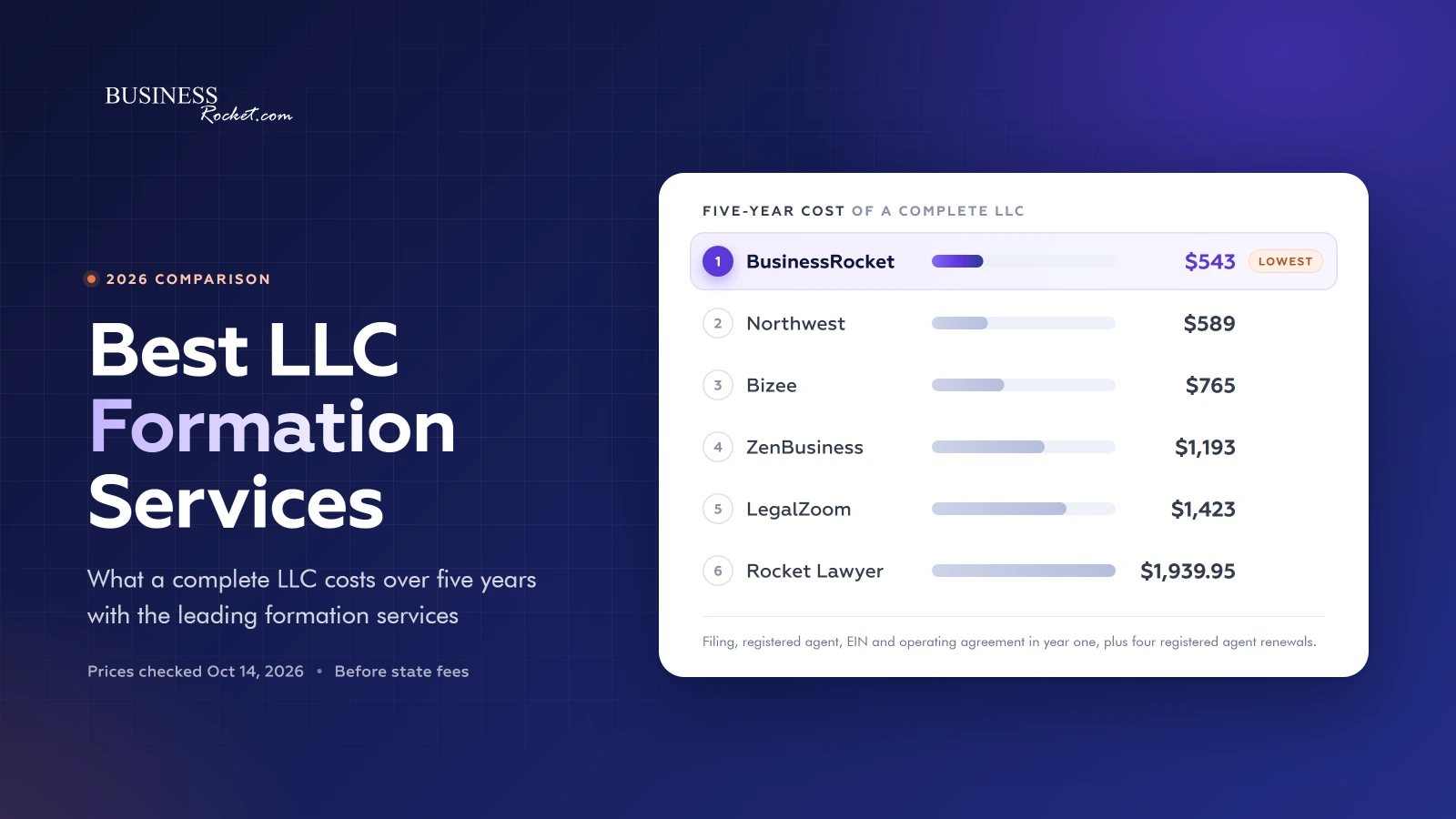
Start with Northwest →Lowest 3-year cost we found: Northwest $289 vs Bizee $298 vs ZenBusiness $497 (service fees; state fees extra). Northwest also puts its address on your public filings instead of yours where the state allows.
Time Comparison: What DIY Filing Actually Takes
DIY proponents often describe LLC filing as “just a simple form.” That is true for the Articles of Organization itself. But the total time investment for a complete DIY filing includes more than form completion.
| Task | DIY Time | Formation Service Time |
|---|---|---|
| Research your state’s specific requirements | 30 to 90 minutes | Not required (handled internally) |
| Business name availability check | 15 to 30 minutes | Automated (included) |
| Download and complete Articles of Organization | 20 to 45 minutes | 10 to 15 minutes (questionnaire) |
| Submit and pay state fee | 10 to 20 minutes | Handled by service |
| Apply for EIN at IRS.gov | 10 to 15 minutes | 10 to 15 minutes (or $50 add-on) |
| Find and vet a registered agent | 30 to 60 minutes | Included (enrolled automatically) |
| Draft or find an operating agreement | 30 to 90 minutes | Included or low-cost add-on |
| Total first-time estimate | 2.5 to 6 hours | 30 to 60 minutes |
The time investment for a careful DIY filing runs 2.5 to 6 hours for a first-time filer who is being thorough. An experienced business owner who has done this before and knows their state’s portal can complete the same process in under 90 minutes. The formation service handles most of this for the price of 30 to 60 minutes (see our full service comparison) of your time and, in some cases, $0 in added fees.
Neither option changes how long the state takes to approve your LLC. State approval is the same whether Northwest files your Articles or you do it yourself. In fast states like Wyoming and Delaware, online filings are often same-day to 2 business days. In slow states like California, Maryland, and New York, approval takes 2 to 6 weeks from submission date regardless of who submits.
DIY Rejection Risk: Causes, Costs, and How Common It Is
Filing errors are more common than most DIY guides acknowledge. Northwest Registered Agent’s corporate filing team, which processes LLC filings in all 50 states, identified the following as the most common rejection causes for self-filed LLCs:
- Business name already taken. The most common rejection cause. State registries are separate from domain registries: a .com domain being available does not mean the business name is available in your state. Some states also reject names that are “deceptively similar” to existing registrations, which requires judgment about what constitutes similarity.
- Restricted words used without licensing. Words like “bank,” “insurance,” “attorney,” “engineer,” “doctor,” and similar professional terms require proof of licensing in most states. Using them without documentation triggers rejection.
- Missing or incorrect registered agent information. The registered agent must have a physical street address in the state (not a P.O. box, not a virtual mailbox). Listing incorrect agent information is a common error for self-filers.
- Incorrect fee payment. Some states have specific payment methods, different fees for online vs. mail filing, or additional fees for specific provisions in the Articles.
- Using an outdated form. States update their Articles of Organization forms periodically. A form downloaded from a third-party website rather than the current official Secretary of State site may be out of date.
- Wrong state portal. Multi-tab browser errors and confusion between similar state website interfaces have resulted in LLCs being filed in the wrong state. Once processed, correction requires amendment fees and sometimes refiling.
Formation services reduce rejection risk significantly because they use state-specific templates updated continuously, run name availability checks before filing, and have in-house staff who know each state’s specific requirements. Northwest Registered Agent’s filing team reviews documents before submission and contacts you if something needs correction. This pre-submission review is the single most valuable thing a formation service provides that DIY cannot replicate.
Privacy: The Difference Most Comparisons Miss Entirely
When you file your own LLC, your registered agent address appears on your state’s public business registry. In every state, you are required to provide an address where legal documents can be delivered during business hours. Most self-filers use their home address.
That home address becomes part of a public database that is indexed by Google, legal research tools, and data brokers within days of your LLC being approved. Compliance mail scammers specifically monitor new LLC filings and target the addresses listed. Your home address enters solicitation lists, broker databases, and public records that are difficult to remove from.
Formation services that list their own address on your state filings solve this problem entirely. Northwest Registered Agent uses their own address on every state filing for every client. Your home address never appears in the public business registry. This protection persists as long as Northwest remains your registered agent.
| Privacy Factor | DIY (Self as RA) | DIY + RA Service | Northwest (Service) | Our Pick |
|---|---|---|---|---|
| Personal address on public registry | Yes | RA’s address listed | Northwest’s address listed | Claim Free Year of Registered Agent → Highest rated + Frédéric’s choice |
| Home address available to data brokers | Yes (immediately) | No | No | – |
| Compliance mail scam exposure | High (within 14 days) | Low | Low | – |
| Data sold to marketing partners | N/A | Varies by RA service | Never (documented policy) | – |
If you operate from your home and value privacy, using yourself as your own registered agent means your home address is public. This is not a hypothetical concern: most LLC owners who file DIY receive compliance mail scams, marketing calls, and data broker listings within two weeks of their LLC being approved. The registered agent service fee is also a privacy fee.
Side-by-Side: Pros and Cons of Each Approach
When DIY Is the Right Choice: 4 Specific Scenarios
DIY LLC filing is not a compromise. For the right person in the right situation, it is the better option. Here are the four specific scenarios where filing yourself outperforms using a service.
If you have navigated your state’s filing portal, know its specific requirements, and understand where the common errors occur, you can complete the process accurately in under 90 minutes. There is no meaningful rejection risk for an experienced filer. You save the service fee and maintain full control. The main remaining question is registered agent: if you want address privacy, hiring a standalone RA service is still worth considering.
States like Wyoming, Delaware, Florida, and Colorado have modern, well-documented online filing systems with clear instructions, real-time name availability checks built in, and same-day approval. In these states, the friction of DIY filing is genuinely low. A first-time filer who reads the instructions carefully can complete the process accurately in 60 to 90 minutes with low rejection risk.
If you operate from a commercial address (office building, retail location) rather than your home, you can designate that address as your registered agent address without privacy concerns. In this case, the registered agent bundling advantage of formation services disappears. You save the service fee and get exactly the same result.
New Mexico still requires a registered agent, but it has no annual report requirement and a low filing fee ($50). The simplicity of New Mexico’s LLC requirements makes DIY filing genuinely straightforward, and the privacy concern is reduced since registered agent listing rules differ. For specific business reasons to form in New Mexico, DIY is the lowest-friction option.
When a Formation Service Is the Right Choice
The combination of unfamiliarity with your state’s portal, uncertainty about which fields are required, and the real cost of rejection errors makes a formation service worth its fee. At $39 or less for the best services (or $0 for Bizee), you are buying insurance against a $75 to $500 rejection cost and weeks of delay. This is especially true in states with complex requirements or slow approval timelines.
If your home address would otherwise appear on public state records, using a formation service that lists their address on your filings eliminates that exposure permanently. The privacy value alone justifies the service fee for most home-based business owners. Northwest Registered Agent’s address-on-filings feature is not available if you file DIY and designate your own registered agent separately.
At a $39 service fee and 3 to 5 hours of DIY time saved, you are paying roughly $8 to $13 per hour for the service. If your billable rate or business value per hour is above that, the math clearly favors the service. Most small business owners cross this threshold easily.
New York requires publication of LLC formation in two local newspapers for six consecutive weeks (cost: $500 to $1,200 depending on county). California changed its filing process in 2025 to online-only. Massachusetts has a $500 filing fee and complex naming requirements. Maryland has historically slow processing. In states with additional requirements beyond simple form filing, the state-specific knowledge that formation services carry reduces both error risk and the time you spend researching.
Annual report deadlines vary by state, and missing them results in penalties of $50 to $500 or administrative dissolution of your LLC. Formation services track your annual report deadline and notify you. DIY filers must track this themselves. If you are not confident you will remember state-specific annual deadlines across multiple years of operation, the compliance alert value of a formation service is real and ongoing.
$39 formation, registered agent free year one, their address on your state filings, never sells your data, Corporate Guides support in all 50 states. $289 true 3-year cost. No auto-enrolled subscriptions.
State Complexity: Where DIY Gets Harder
The difficulty of DIY filing varies significantly by state. Filing in Wyoming is genuinely simple. Filing in New York is genuinely hard. Here is a quick reference by state type:
| State | DIY Difficulty | Key Complication | Online Approval Speed |
|---|---|---|---|
| Wyoming | Easy | Simple portal, clear instructions, low fee ($100) | Same-day |
| Delaware | Easy | Well-documented process, flat fee ($110) | Same-day to 1 day |
| Florida | Easy | Clear online portal, $100 fee, fast approval | Same-day to 1 day |
| Texas | Easy | Straightforward; $300 fee; good instructions | 2 to 3 business days |
| California | Moderate | Online-only since 2025; $70 fee; Statement of Information due within 90 days | 2 to 3 business days |
| Illinois | Moderate | $150 fee; publication requirement in some counties | 1 to 3 business days |
| Maryland | Moderate | $100 fee; historically slower processing; SDAT portal can be confusing | 4 to 6 weeks (standard) |
| New York | Hard | $200 filing fee + mandatory newspaper publication in 2 papers for 6 weeks ($500 to $1,200 cost). Total formation cost often $700 to $1,400. | Standard: 2 to 4 weeks |
| Massachusetts | Hard | $500 filing fee; specific naming requirements; SOC filing required | 4 to 6 weeks |
| Arizona | Hard | Publication requirement in approved newspapers for 3 weeks; different county rules | Varies by county |
For New York, Arizona, and Illinois (Cook County), the publication requirement is the main complication. Formation services that have existing relationships with qualifying publications can negotiate lower publication rates, which is a genuine cost advantage for New York filers specifically. Northwest Registered Agent and other major services handle New York publication as an add-on and typically negotiate rates below what individual founders pay when approaching newspapers directly.
If You Use a Formation Service: Our Verified Picks for 2026
If you have decided a formation service is the right path, these are the two services we recommend based on our 12-point evaluation methodology covering pricing transparency, data privacy, filing accuracy, support quality, and registered agent renewal rates.
Our recommended service: Northwest Registered Agent
$39 formation, registered agent included free year one, $125/year renewal. Their address on all state filings (your home address stays private). Never sells your data. Dedicated Corporate Guides in all 50 states. No auto-enrolled subscriptions. True 3-year cost: $289 before state fees. The most transparent pricing structure in the industry.
Form Your LLC with Northwest for $39 →
Affiliate disclosure: we earn a commission at no extra cost to you. We only recommend services we have independently evaluated.
Budget alternative: ZenBusiness
$0 formation fee with a clean dashboard, compliance alerts, and worry-free guarantee. Registered agent service is $199/year. Good choice if $0 upfront formation is a firm constraint.
For a full comparison of five services across 12 criteria including customer support quality, checkout transparency, and state-by-state processing speed, see our complete LLC formation service checklist.